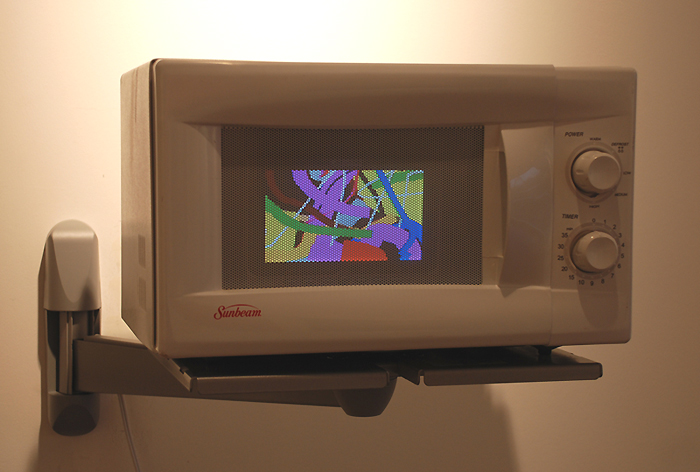
This is a video-painting-appliance type deal. The TV is in the microwave. Profound?! The video shows a slowly-rotating, generative, random algorithm in its process of creating pictures which are then eventually 'cooked' back into the 'noise' of the universe, from whence the random numbers originally came. 10 different pictures are created/cooked on the DVD. It also gives new meaning to the idea of low resolution digital art, as the viewer is forced to see the video through a low-res benday dot screen that naturally occurs on the microwave door. The DVD video plays on a TV screen in a 'black cube' space which is inside a 'white cube' microwave. Perhaps it plays with the different 'theaters' of art and media viewing (and theaters of consumption in general). If you don't know what I mean about white cubes and black cubes, let me briefly explain...
The White Cube, while being the name of a famous British gallery, is also a moniker for the worldwide cultural and physical space of the fine arts, basically galleries, museums, dealers, collectors, the whole 9 yards. White walls, rectangular rooms, lots of light, and high prices. Traditionally, these spaces show painting, sculpture, photography, and sometimes installation. The Black Cube is a newer spin-off moniker which references similar types of art spaces, but ones that are displaying new media art forms like video, internet, electronic, or software art which are often shown in the dark. The black cube is slowly, barely being integrated with the white cube. (not that everyone wants this to happen) It has only recently become more common to see these types of art in white cube spaces, and typically only in the larger urban areas. This has not been and is still not an easy integration. Many white cube spaces don't grok the nuances of the materials and cultures involved, and most disappointingly they don't have the facilities to adequately display new media art. The black cube does, usually providing more control over the sound and lighting atmosphere, as well as better power and network connectivity, among other things. So anyway this piece tries to "solve" the cube issues (albeit half-heartedly) by placing the black cube INSIDE of the white cube. When it was recently shown in a white cube gallery alongside paintings and sculptures, it fit right in with no trouble at all!
But this whole idea is perhaps half-baked.